Clive Broadbent
A life in engineering: career, research, professional achievements and published work.
Overview
Clive Broadbent graduated from RMIT in Melbourne and built a career in mechanical and building-services engineering. His work has included research into Legionella in cooling towers, standards development, and projects in Australia and overseas.
Clive in conversation
Career History
Clive Broadbent’s career includes independent engineering consultancy based in Canberra, specialising in risk management of building services hazards such as control of Legionella, the causative agent for Legionnaires’ disease. He has over 50 years of experience in the HVAC&R industry including working for many key Government projects both in Australia and internationally.

Mechanical engineering and project delivery
For most of his career Clive was a mechanical engineer in the former Federal Department of Housing and Construction (the Federal Government’s principal building construction authority) located in the Melbourne office. This career, from Junior Engineer to its Principal Mechanical Engineer there, began in 1959 after completion of a government cadetship and then national military service.
Clive’s work was mainly that of a designer for mechanical systems including air conditioning at government laboratories, hospital operating theatres, industrial ventilation systems (acid baths for aircraft parts, paint spray booths), airport baggage systems (Tullamarine), airport aerobridge design, cargo handling, steam and hot water systems. The design work also included fire safety systems, emergency power generation, office building air conditioning, telephone exchange air conditioning, and many other building services.
His responsibilities in project delivery involved the full range of activities from client briefing to design development, documentation, contract supervision, plant commissioning and eventually senior management.
National role and cooling-tower research
In 1983 Clive moved to Canberra to take up the national role of that Department’s Chief Mechanical Engineer which was the position he held until 1993 (the highest level of mechanical engineer in the Federal public service) when he completed service and began his consulting practice.
Over the period 1988 to 1993 he also managed a field research project into the ecology of Legionella in cooling towers (devices for building heat rejection) and has published widely on the findings. The work resulted from direct government ministerial request following an outbreak of Legionnaires’ disease associated with a government facility.
This unique work, which had not been carried out anywhere in the world prior to this initiative, nor has it been replicated since, established by statistical techniques the key indicators to Legionella growth and potential for disease using a large number of cooling towers in normal operation.
Independent practice
Clive Broadbent & Associates Pty Ltd
Clive is the owner of Clive Broadbent & Associates Pty Ltd. Refer www.broadbent.com.au.
Research and standards
Legionella research and consultancy
Clive Broadbent graduated from RMIT (Melbourne). His specialty has been reports on preventive measures for Legionnaires’ disease hazards such as may be presented by cooling towers.
With a team comprising microbiologists, medical personnel and other engineers, he carried out an extensive field study into Legionella ecology in cooling towers. The field study included research into the effectiveness of biocides and water treatment approaches.
Clive has been involved as an engineering consultant at most of the Australian outbreaks of Legionnaires’ disease, one in New Zealand and one in the USA. These included the Melbourne Aquarium outbreak in 2000, the Wollongong outbreak in 1987 and the Adelaide outbreak in 1986.
Standards development
Former Chair of the committee responsible for AS/NZS 3666, Air-handling and water systems of buildings — Microbial control. Clive was the originating author for this standard.
His standards work has also included voting membership of the ASHRAE committee responsible for developing a risk management standard on Legionellosis.
His standards work included membership of several committees of the Standards Association of Australia.
Read about his research and standards contributions and related publications.
Projects and international work
Clive’s experience includes preparing Risk Management Plans for sites including paper mills, chemical manufacturers and refineries, mining sites, and power stations as well as a plethora of educational premises, hospitals, aged care facilities and commercial buildings having cooling water systems and air-handling plants that may potentially present hazards to health.
Some of the more interesting assignments included:
- Many aspects of Tullamarine Airport including HVAC for several buildings associated with the airport such as the Airworthiness Building and Police Building – full design work.
- HVAC designs for many laboratory complexes including those for CSL at Parkville and Broadmeadows, and for CSIRO at Clayton, Parkville, Merbein and Geelong.
- Air conditioning designs for PNG Defence Signals Buildings in Port Moresby and the Highlands at the time of the Indonesian confrontation episode (1964).
- HVAC designs for some large-scale electronic telephone exchanges including Windsor and Exhibition in Melbourne, and Launceston in Tasmania.
- Key reviews and approvals on mechanical plant for the new Parliament House in Canberra.
- Key design reviews and on-site commissioning supervision for the new Australian Embassy in Beijing (1991).
- Key design reviews on HVAC plant proposed for the Tindal Air Force base in Tindal, NT.
- Planning and design work for the proposed Commonwealth Centre building complex in Melbourne.
- Design input for mechanical services at Antarctic Division HQ at Kingston (Hobart), at the Cape Grim (Tas) baseline environmental monitoring station, for the Federal Law Courts in Hobart, and ABC studios Hobart.
- Ventilation for the Defence Indoor Weapons Firing Range at Swanbourne, Perth.
Parliamentary and expert-witness work
Other Federal parliamentary involvements circa 1985 to 1993 included representing the Department of Housing and Construction on building services for public works hearings around Australia (Sydney Harbour Naval Base, Tindal Air Force Base, Puckapunyal Armoured Division, Watsonia Army School of Music, and other places) and also separate presentations to parliamentary hearings on the specific topics of energy management, indoor air quality, and Legionella control measures. All recorded in Hansard.
Clive has, since working from 1993 as a private consultant, been an expert witness at parliamentary hearings in NSW (Legionella control) and the ACT (tobacco ventilation regulations) plus as an adviser (friend of the court) in Queensland for an environmental enquiry on several developments in that state.
Beijing, 2003
In May 2003 Clive worked in Beijing at the request of the World Health Organization as the only engineer in its SARS response team. The work concerned SARS transmission and ventilation in hospitals and other public buildings.
He carried out hospital investigations alongside medical and scientific specialists, including the use of smoke-tube techniques to investigate air movement. The assignment led to reports, published papers and seminars in Australia, bringing his engineering experience to a wider public-health setting.

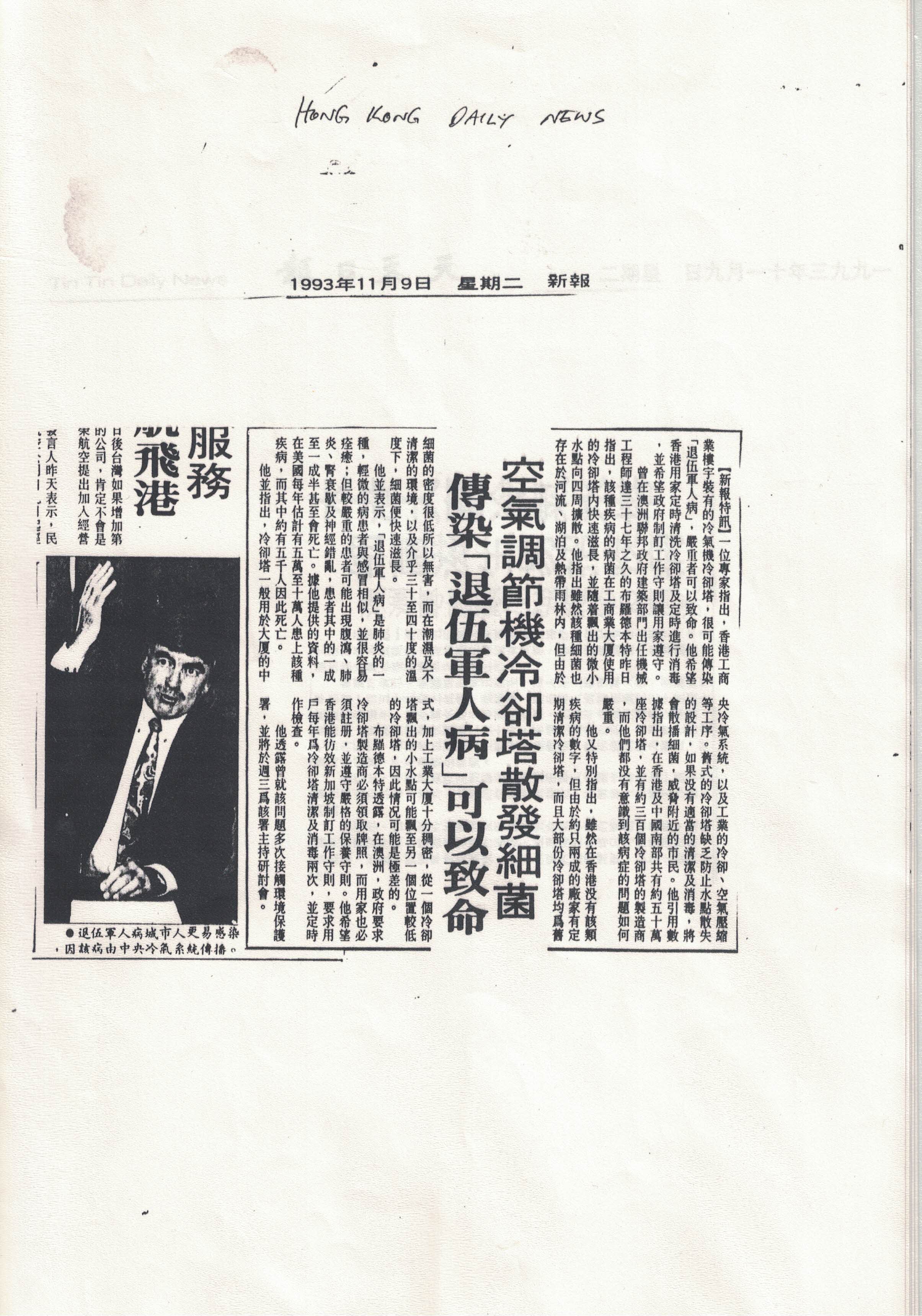
Hong Kong, 1993
A Hong Kong newspaper report from 9 November 1993, following Clive’s talk on indoor air quality.
Honours and awards
During this career Clive has acquired many awards which include:
- 1953 – Hawke Medal for Dux of School (Preston Technical College, Melbourne)
- 1969 – Distinctive Service Medal for the design of luggage conveyors at Tullamarine and Perth Airports, design of aerobridges for Tullamarine, design of automatic door openers (a new initiative at that time) for Tullamarine, and design of mechanical handling facilities for freight at Sydney Airport.
- 1985 – Roy Ahern Best Paper award (AIRAH) for the year (co-author, topic: energy targets)
- 1987 – Roy Ahern Best Paper award for the year (topic: Legionella control)
- 1987 – ASHRAE Best Paper award for the year (co-author, topic: energy targets)
- 1992 – James Harrison Medal (the annual AIRAH highest award for services to the building services industry), presented at AIRAH’s annual meeting in March 1993.
- 1998 – CIBSE National Conference, Bournemouth (UK) – best technical paper
- 2000 – Appointed a Member of the Order of Australia (AM)
- 2012 – Inducted into the ARBS Hall of Fame (the Australian overall building services industry’s highest award) — recognition by the building-services consortium for building-services achievements in Australia.
- 2019 – ASHRAE Distinguished Service Award
Australia Day 2000
Clive was appointed a Member of the Order of Australia (AM) in the 2000 Australia Day Honours. The recognition honours his contribution to environmental health and safety in mechanical building services, particularly the control of Legionella risks in cooling towers.
ASHRAE Distinguished Service Award
In June 2019, Clive received ASHRAE’s Distinguished Service Award at its Annual Conference in Kansas City, Missouri, recognising his contributions to the Society.

From The Canberra Times
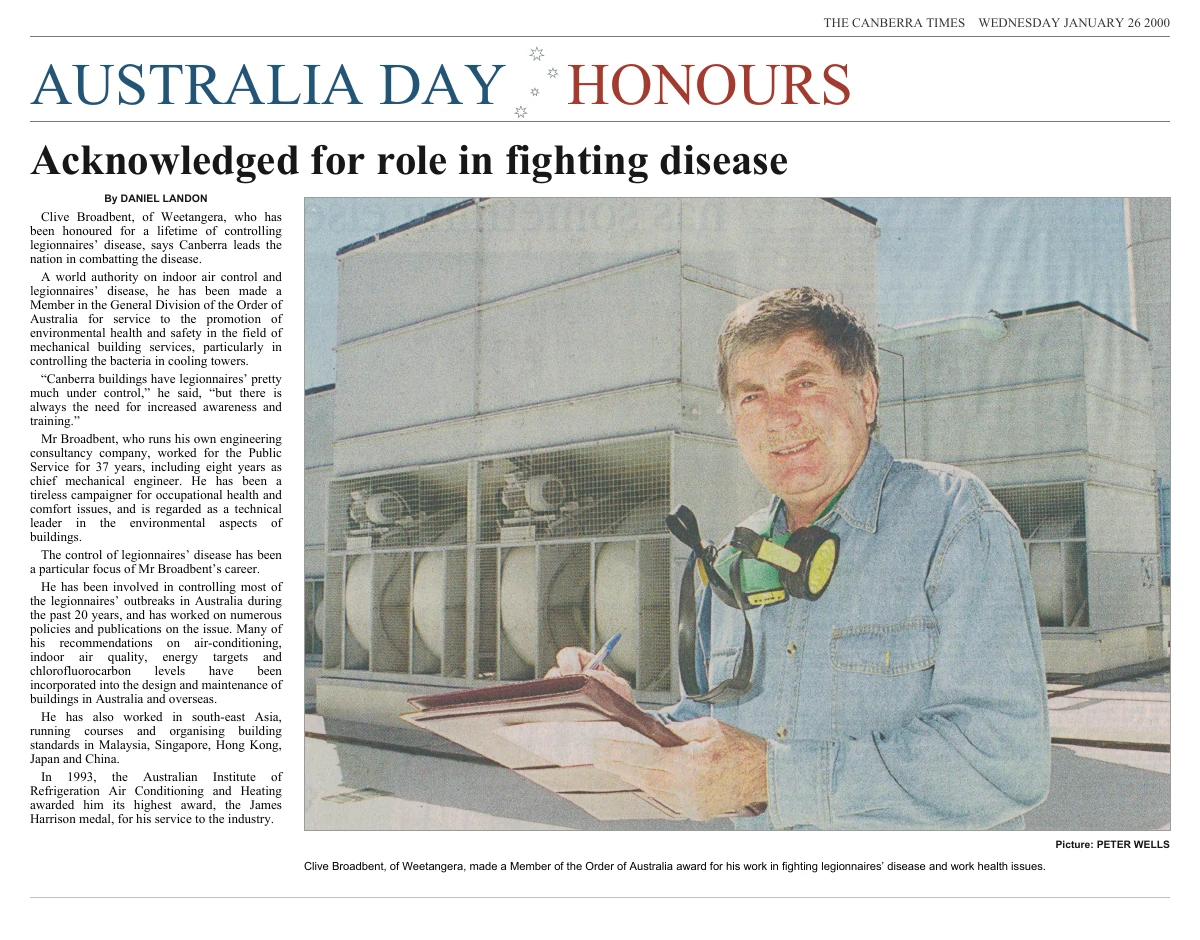
The Canberra Times marked the occasion on 26 January 2000 with Daniel Landon’s article, “Acknowledged for role in fighting disease”, and a photograph by Peter Wells.
Read the newspaper article (PDF, 2.3 MB)
The article text is also available below.
Read the article text
THE CANBERRA TIMES WEDNESDAY JANUARY 26 2000
AUSTRALIA DAY HONOURS
Acknowledged for role in fighting disease
By DANIEL LANDON
Clive Broadbent, of Weetangera, who has been honoured for a lifetime of controlling legionnaires’ disease, says Canberra leads the nation in combatting the disease.
A world authority on indoor air control and legionnaires’ disease, he has been made a Member in the General Division of the Order of Australia for service to the promotion of environmental health and safety in the field of mechanical building services, particularly in controlling the bacteria in cooling towers.
“Canberra buildings have legionnaires’ pretty much under control,” he said, “but there is always the need for increased awareness and training.”
Mr Broadbent, who runs his own engineering consultancy company, worked for the Public Service for 37 years, including eight years as chief mechanical engineer. He has been a tireless campaigner for occupational health and comfort issues, and is regarded as a technical leader in the environmental aspects of buildings.
The control of legionnaires’ disease has been a particular focus of Mr Broadbent’s career.
He has been involved in controlling most of the legionnaires’ outbreaks in Australia during the past 20 years, and has worked on numerous policies and publications on the issue. Many of his recommendations on air-conditioning, indoor air quality, energy targets and chlorofluorocarbon levels have been incorporated into the design and maintenance of buildings in Australia and overseas.
He has also worked in south-east Asia, running courses and organising building standards in Malaysia, Singapore, Hong Kong, Japan and China.
In 1993, the Australian Institute of Refrigeration Air Conditioning and Heating awarded him its highest award, the James Harrison medal, for his service to the industry.
Picture: PETER WELLS
Clive Broadbent, of Weetangera, made a Member of the Order of Australia award for his work in fighting legionnaires’ disease and work health issues.
Professional memberships
- Fellow and Life Member of Engineers Australia
- Fellow and Life Member of AIRAH — Australian Institute of Refrigeration, Air Conditioning and Heating
- Fellow and Life Member of ASHRAE — American Society of Heating, Refrigerating and Air-Conditioning Engineers
Former registration in mechanical engineering and building services engineering.
Teaching and presentations
Clive has prepared many teaching modules for the TAFE sector and other educational institutions and has contributed significantly to many of the AIRAH Design Application Manuals; he is the author of those on maintenance, water treatment and indoor air quality.
Clive’s work has included regular contact with Australian Government authorities such as the state health departments and contributions to regulatory publications, including those for international engineering and public health authorities. He has travelled many times to conferences in Europe, Asia and the USA and has presented over 120 technical papers, many overseas.

Professional contributions
- Author of 12 TAFE modules on air conditioning systems
- Author of over 120 technical publications such as conference papers, journal articles, books and monographs
- Won AIRAH Journal annual best paper award twice
- Certificates of appreciation from engineering institutes in Hong Kong, Singapore and Malaysia
- Keeps in touch with an international network of microbiologists, chemists, engineers, health officials and others who have a special interest in the control of Legionella
Clive is a man of engineering and also of faith. He feels that having a Christian faith is actually both enriching and complementary to use of the tools of mechanical engineering for the betterment of physical health, security and safety in our natural world; areas that need a moral imperative for the common good.